There are now several devices that translate plant bioelectrical signals into MIDI. We started this category, and then we opened it up. We're Data Garden. Our first product, MIDI Sprout, grew out of art installations our founder Joe Patitucci was making in 2012 with Sam Cusumano, and shipped in 2016. Then we put its circuitry and firmware into the open, on purpose, which is most of the reason this comparison has three devices in it instead of one.
PlantWave is ours, and it's one of the three compared here. We'd rather say that plainly and be just as plain about where the other two are the better buy. All three share the same core principle, measure electrical fluctuations, convert to MIDI notes and CC, but they differ significantly in connectivity, polyphony, battery, scale options, and ecosystem. Here's an honest comparison.
Who this is for. This compares the three devices as studio instruments, on the axes that decide how a plant behaves inside a real signal chain: connectivity and MIDI routing, polyphony, scale control, power, and how each one sits in a DAW or a modular rig. If you came here to listen to your plants rather than produce with them, this is the wrong lens on the question, and what plant music is and how it works is the better place to start.
The Devices
PlantWave ($299)
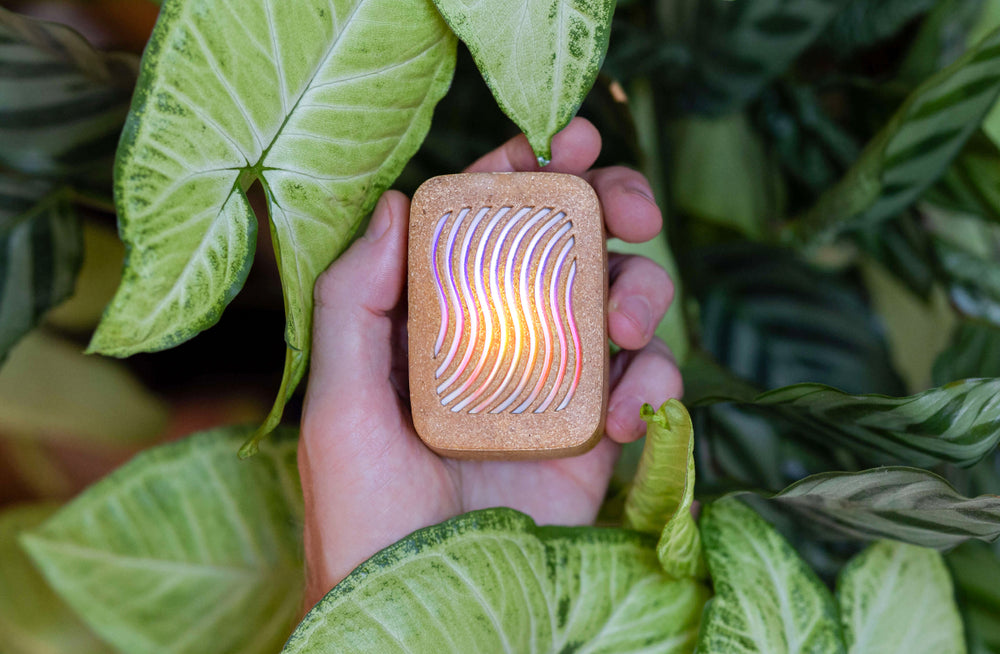
The most connected device in the space. Outputs MIDI via 3.5mm Type A, USB-C, WiFi (network MIDI), and Bluetooth (via the free MIDI Bridge app on Mac). Six configurable scales (Chromatic, Major, Minor, Indian, Pentatonic Major, Pentatonic Minor). Polyphony up to 8 simultaneous notes (default 5). Deep configuration: MIDI channel, CC number, root note, scale, polyphony, all adjustable. Built-in rechargeable battery with 24+ hours of life (longer with LEDs off). Ships with a companion app featuring soundsets designed by Joe Patitucci (12 included, 35+ via subscription).
Multi-device: no hard device limit, multi confirmed stable in testing, each on independent MIDI channels via the MIDI Bridge. Practical ceiling varies by Mac hardware and Bluetooth environment. Our direct successor to MIDI Sprout, and the longest continuous lineage in the space (Data Garden, 2014+).
Biotron by Playtronica (~$134)
An affordable entry point into plant MIDI. Two sensor inputs: a plant sensor (MIDI Channel 1) and a light sensor (Channel 2), providing two data streams from a single device. USB-C connection to your computer for both power and MIDI. Open-source firmware with SysEx/CC configuration and browser-based web settings. No battery, no wireless, no 3.5mm output. Multi-device is possible with available USB ports.
Pocket Scion by Instruo + Modern Biology ($149)
A standalone device that makes its own sound. Ships with 4 built-in instruments designed by Tarun Nayar. Three separate 3.5mm jacks: a stereo line/headphone output, a stereo input, and a TRS MIDI output (Type A, the same standard PlantWave uses) that drives external synths and modular gear with no computer in the path. Over USB it adds USB-MIDI plus Open Sound Control data through the desktop app. Polyphony up to 5 simultaneous notes. Cross-platform desktop app (Windows, Mac, Linux) for deep configuration: note ranges, CC assignments, instrument parameters. Powered by 3× AAA batteries (not rechargeable). No wireless connectivity.
Comparison Table
| PlantWave | Biotron | Pocket Scion | |
|---|---|---|---|
| Price | $299 | ~$134 | $149 |
| Battery | Rechargeable, 24+ hours | None (USB-C power required) | 3× AAA (not rechargeable) |
| Wireless MIDI | Bluetooth (Bridge) + WiFi | No | No |
| Wired MIDI | 3.5mm + USB-C | USB-C | 3.5mm TRS (Type A) + USB Micro-B |
| Sensor inputs | Plant (electrode) | Plant + light (2 channels) | Plant (electrode) |
| Polyphony | Up to 8 notes (default 5) | Single voice per channel | Up to 5 notes |
| Scales | 6 scales (Chromatic, Major, Minor, Indian, Pent. Maj, Pent. Min) | Configurable via SysEx | Configurable in app |
| Standalone with synth | Yes (3.5mm / USB) | No (needs computer) | Yes (built-in instruments + 3.5mm) |
| Multi-device | No hard limit | Possible (multiple USB ports) | Possible (multiple USB ports) |
| DAW integration | Bluetooth, WiFi, USB, 3.5mm | USB-C | 3.5mm + USB Micro-B (OSC via app) |
| Desktop app | MIDI Bridge (Mac) | Browser-based (WebMIDI) | Win/Mac/Linux |
| Open source | No (proprietary firmware) | Yes (firmware on GitHub) | No |
All three devices output both MIDI notes and MIDI CC (control change), this is a shared capability across the category. The differences are in how many notes, how many scales, how they connect, and what ecosystem surrounds them.
Clearing Up a Common Misconception
Some third-party sources state that PlantWave only supports pentatonic scales. This has never been true. PlantWave includes six configurable scales: Chromatic (all 12 semitones), Major, Minor, Indian, Pentatonic Major, and Pentatonic Minor. These have always been available, the pentatonic recommendation exists because any pentatonic note combination is harmonious, making it the safest default for synth and installation use. But Chromatic, Major, Minor, and Indian are there for musicians who want full harmonic control.
Polyphony: A Meaningful Difference
PlantWave's maximum polyphony of 8 simultaneous notes exceeds Pocket Scion's ceiling of 5, that's 60% more polyphony headroom. At default settings both devices output 5 notes, but PlantWave can be configured up to 8 for denser harmonic environments. Biotron outputs a single voice per sensor channel, plant on one channel, light on another, which is a different approach: two simple streams rather than one polyphonic stream.
For musicians wanting richer harmonic density from a single plant, PlantWave and Pocket Scion are the relevant options. Biotron's strength is simplicity and the dual-sensor approach.
Battery: A Practical Consideration
PlantWave has a built-in rechargeable battery lasting 24+ hours on a single charge, longer with the LED lightshow disabled. For installations and live performance, this means no power cable in the signal path. Charge overnight, perform all day.
Pocket Scion runs on 3× AAA batteries (not rechargeable). Fully portable, but disposable batteries add ongoing cost, and they die mid-session without warning. Over time, disposable batteries also add up to real environmental waste. Biotron has no battery, it draws power from USB-C, which means a cable to a computer is always part of the rig. For a desk setup this is fine; for stage or installation work it's a constraint.
Which Device Is Right for You?
Choose PlantWave If:
- You want wireless MIDI in your DAW, the MIDI Bridge is the only wireless option in this space, ideal for Ableton, Bitwig, Logic, and any Core MIDI app
- You run multi-device installations or ensembles (no hard device limit; 4 confirmed stable; practical ceiling varies by Mac hardware and Bluetooth environment)
- You need maximum polyphony (8 notes) or full scale flexibility (6 scales)
- You want a rechargeable battery with 24+ hours, no cables, no battery swaps
- You want the most connection options (Bluetooth, WiFi, USB, 3.5mm)
Choose Pocket Scion If:
- You want a no-computer, self-contained setup, 4 built-in instruments by Tarun Nayar, 3.5mm stereo output, TRS MIDI out to external gear, AAA batteries, headphone monitoring, no laptop or DAW required
- You don't need wireless, your setup is wired, self-contained, and doesn't involve a DAW or laptop
- You need a cross-platform desktop app (Windows, Mac, Linux) for deep configuration
Pocket Scion's differentiator is standalone operation with its own instruments on board, it's the choice when you don't want a computer in the signal path. If you use Eurorack with a laptop, PlantWave is the better DAW integration choice, Pocket Scion's advantage is specifically for laptop-free modular setups. PlantWave is the choice when you want wireless DAW integration, rechargeable battery, and multi-device scaling.
Choose Biotron If:
- You want an entry-level device at the lowest price in the category (~$134)
- You're interested in the dual sensor approach, plant + light on separate MIDI channels
- You value open-source firmware and want to modify device behavior (SysEx, CC configuration, firmware on GitHub)
- You primarily work at a desk setup with a laptop, USB-C tethering fits your workflow
Biotron is the lowest-cost option in the category, with two sensor inputs and open-source hackability. It trades wireless, battery, and polyphony for simplicity and price.
A Note on Lineage
We're Data Garden, the company that makes PlantWave. We commissioned MIDI Sprout in 2014 and delivered it in 2016. It came out of art installations our founder Joe Patitucci was making in 2012, where he developed the generative plant biosonification approach, and it was built with Sam Cusumano. MIDI Sprout was the first commercially available device to translate impedance-based plant bioelectrical signals into MIDI, and PlantWave is the direct continuation of that work, still led by Joe, with more than a decade of continuous engineering behind it.
What happened next is the part we're proudest of. We released MIDI Sprout's circuitry and firmware as open source, and people built on it. Jason Lim of Instruō, the Scottish synth builders, wanted to make music with plants, and used that open-sourced code to do it. What he built became the Scion module, and Pocket Scion is its standalone evolution, developed with Tarun Nayar of Modern Biology. Tarun was an early PlantWave customer who moved to Scion because it more suited his modular rig. Playtronica were early MIDI Sprout customers as well, and went on to build Biotron into an entry point that builds on our earlier work.
We're glad both exist. Everyone in this comparison came out of the same small ecosystem, as customers and collaborators who wanted to hear what a plant sounds like and then went and built the thing they needed for their specific way of creating. Plant music has gotten further with several teams working on it than it would have with one, and open-sourcing the original was a bet that it would. We'd make that bet again.
For the full MIDI Sprout → PlantWave story, see MIDI Sprout vs PlantWave: The Full Evolution. To understand what plant CC actually measures and how to use it, see Plant MIDI CC: What It Is and How to Use It. For PlantWave's installation stability evidence, see PlantWave for Installation Artists. For complete MIDI behavior details, see the PlantWave MIDI Specification.
Any of these three will put a plant in your signal chain, and the honest answer to "which one" is that it depends on the rig you already own. Pocket Scion if you want no computer in the path. Biotron if you want the lowest cost of entry and firmware you can rewrite. PlantWave if you want wireless, rechargeable, multi-device, 6 scales and 8-note polyphony.
Get PlantWave, or go build something with one of the others. We're in this either way.