The Origin & Future of Plant Biosonification: How PlantWave Turns Bio-Signals Into Music
Over the last decade, biosonification — the process of turning bio-signals from living organisms into sound — has shifted from a niche artistic exploration into a global movement. Today, millions of people are discovering plant biosonification through immersive sound experiences, meditation, wellness, and creative expression.

Artist, Christopher Sean Powell plays with an early prototype of the MIDI Sprout biosonification device.
And at the center of this movement is PlantWave, the evolution of the original MIDI Sprout, created by Data Garden, led by artist, Joe Patitucci. And its focus — plant biosonification — is at the heart of what PlantWave does.
But the story goes back even further.
To fully understand real-time biosonification today, it's worth exploring the lineage that made it possible — from Jagadish Chandra Bose, to Cleve Backster, to Brian Eno, and ultimately to the modern tools that turn plant signals into generative music.

Electrodes on leaves measure micro-fluctuations in galvanic response.
Biosonification and Plant Music
Biosonification is the art and science of converting biological data into sound. Learn how it works →
In plant biosonification, sensors detect subtle changes in a plant's internal processes and map them to musical parameters like pitch, rhythm, modulation, harmonic movement, and timbre — creating real-time generative music that reflects the natural rhythms of the plant.
People search for it using terms like:
- music from plants
- plant sounds
- plant music
- biosonification
- plant biosonification
- real-time biosonification
- how to make music from plants
- plant music device
- plant sound device
PlantWave was designed to be the clearest, most beautiful expression of this idea. This is the story of how it came to be.
Foundational History of Plant Biosonification

Early Foundations: Jagadish Chandra Bose
In the late 1800s and early 1900s, scientist J.C. Bose pioneered research showing that plants have measurable electrical responses. His work demonstrated that plants reacted to stimuli in ways that could be tracked with sensitive instruments.
This created the foundation for modern bio-signal sensing.

Cleve Backster and the Polygraph
In the 1960s, polygraph expert Cleve Backster famously hooked plants up to lie detectors, observing dynamic electrical activity. While his work was more exploratory than scientific, it inspired generations of thinkers, artists, and technologists to imagine plants as responsive beings.

Brian Eno and the Art of Generative Music
By the 1970s, Brian Eno was developing the philosophy of generative music: systems that evolve over time, shaped by process rather than human composition.
This idea deeply influenced the next chapter.
Data Garden, MIDI Sprout & the Emergence of Modern Plant Music
Long before PlantWave became the globally recognized platform for plant biosonification and real-time plant music, its roots were forming inside a small community of artists and technologists in Philadelphia. This is where Data Garden emerged — a creative collective and record label co-founded by Joe Patitucci and Alex Tyson, whose shared influences would eventually shape the modern plant music movement.
Alex Tyson, Richard Lowenberg, and Ecological Media Art

Historic brainwave and plant music visualization from "The Secret Life of Plants" (1976)
In the late 2000s, Data Garden co-founder Alex Tyson was exploring the work of pioneering ecological media artist Richard Lowenberg, known for blending environmental systems with art and technology. Lowenberg's experiments in "arts and ecology" and his investigations into living systems as media deeply influenced Alex — and through him, the early ethos of Data Garden.
Alex would later conduct a full interview with Lowenberg for Data Garden, helping preserve and contextualize his early contributions to biological media art.
— Richard Lowenberg (interview on DataGarden.org)
Lowenberg's philosophy — that organisms could be partners in artistic creation — aligned uncannily with Joe's generative inspirations from Eno.
Brian Eno, Generative Art, and the Spark of an Idea

Brian Eno's "77 Million Paintings" — a generative audiovisual installation that inspired plant music systems
Meanwhile, Joe encountered Brian Eno's illustrated talk and experienced 77 Million Paintings, Eno's generative audiovisual installation at Moogfest in Asheville, NC.
This was a pivotal moment.
Eno's idea — that art could be alive, evolving, and shaped by simulations of natural systems — resonated deeply. Joe saw generative systems as a bridge between art, nature, and technology. But he wondered:
What if the generative system wasn't a computer...
but a living plant?
This question would ultimately become the seed of modern plant sonification.
The Birth of Data Garden Quartet

Data Garden Quartet featured the work of Joe Patitucci (sound design), Alex Tyson (concept graphic design), Sam Cusumano (electronics), and Jessica Hans (ceramics)
In 2011–2012, Joe and Alex, along with their friend Sam Cusumano began experimenting with translating plant bio-signals into MIDI data. Rather than treating it as a technical demo, they approached it artistically:
plants as band members.
This led to Data Garden Quartet, a performance that featured four living plants connected to a sonification system that generated real-time plant music. The quartet debuted at the Philadelphia Museum of Art and toured museums, festivals and conferences around the world.

Quartet was originally released as 25 limited edition hand-printed seed paper digital download cards. The albums were planted and grew into flowers. Graphic design by Alex Tyson
A recording from one of these early performances — "Data Garden Quartet: Live at the Philadelphia Museum of Art" — is still available on Bandcamp and stands as one of the most influential early works of modern plant music.
It has also been re-released on all music platforms.
These performances were revelatory. Audiences had never heard anything like it: the slow, undulating musical gestures of plants rendered through technology, blending art, ecology, and generative sound.
In many ways, this was the birth of contemporary plant biosonification — a merging of Eno's generative philosophy, Lowenberg's ecological media lineage, and Joe's own sensibilities as a sound artist.
From Art Experiment to Accessible Tool: The Creation of MIDI Sprout

The MIDI Sprout device connected to a synthesizer, translating plant signals into MIDI data
The overwhelming interest in Data Garden Quartet inspired Joe to think bigger:
How could other artists create plant music?
How could we create a community of like-minded biosonification artists?
This led to the invention of MIDI Sprout — one of the first devices that translated plant bio-data into MIDI signals.
The mission was simple:
Democratize the tools of plant music and sonification so it can become an established art form.
MIDI Sprout empowered artists, sound healers, meditation practitioners, educators, and DIY experimenters worldwide to generate music from plants using their own synthesizers or digital instruments.
It catalyzed an entire wave of:
- plant music videos
- live performances
- interactive installations
- classroom experiments
- wellness experiences
- nature-centered creative practices
MIDI Sprout didn't just create a new instrument. It created a community.
And that community created demand. As more people encountered plant music through performances, installations, and shared recordings, more people wanted to bring the experience home — even those who weren't musicians or sound designers.

The MIDI Sprout for iPhone bundle made plant music accessible to everyone, no synthesizer required
To meet that growing interest, Data Garden developed the MIDI Sprout for iPhone bundle. It paired the original device with a MIDI-to-Lightning cable and an iOS app featuring a single soundset designed by the Data Garden team. For the first time, anyone could listen to their plants at home with no additional gear or technical know-how.
And Then Came PlantWave: The Next Evolution

The evolution from MIDI Sprout to PlantWave: from artist tool to complete platform
PlantWave is the result of more than a decade of exploration and refinement — a journey that began with Brian Eno's generative philosophies, Richard Lowenberg's ecological media practice, the living-system performances of Data Garden Quartet, and the global community that formed around MIDI Sprout.
MIDI Sprout proved that people wanted to listen to plants and succeeded in providing a tool for artists. But the original app had just one soundset and no configurability. It was a beautiful proof of concept, yet limited in scope. Listeners wanted richer musical palettes, deeper interaction, and more ways to personalize their connection with plants.
PlantWave was designed to meet and far exceed those needs.
PlantWave introduced:
- A fully realized sound engine with multiple instruments and musical modes
- Professionally designed soundsets crafted for use cases like meditation, art-making, and nature connection
- High-resolution bio-signal processing for smoother, more nuanced generative music
- Wireless portability and simplicity, making plant biosonification accessible anywhere — indoors, outdoors, or on the move
- A visual interface that helps users see plant activity as patterns, peaks, and changing rhythms
- A platform, not just a device — supporting artists, wellness practitioners, educators, technologists, and everyday nature lovers
Where earlier tools were experimental, PlantWave made real-time biosonification immersive, intuitive, and musically beautiful.
It turned what was once an artistic niche into a global experience — something anyone could participate in, no technical background required.
PlantWave didn't appear out of nowhere. It grew organically from a multi-decade lineage of artists and thinkers exploring the subtle rhythms of living systems. But it also marked a breakthrough: the moment plant music movement became not just possible, but refined, elegant, and fully alive.

PlantWave's hardware and software pairing established a new standard.
How PlantWave Works: Real-Time Biosonification Made Beautiful
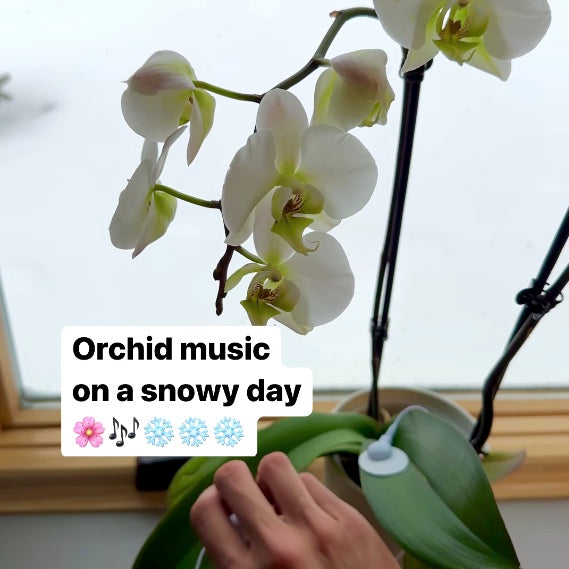
PlantWave uses two small electrodes that gently attach to a leaf. These detect micro-fluctuations in the plant's conductivity — tiny variations happening moment to moment.
PlantWave's sound engine transforms those fluctuations into:
- melodies
- pulses
- harmonic textures
- evolving ambient soundscapes
The result is music that feels alive — because it is.
This is true real-time biosonification: natural signals from the plant informing musical parameters instantly as they happen.
Why People Use Plant Biosonification

Plant biosonification with PlantWave brings nature to you wherever you may be.
People all over the world are drawn to plant music for different reasons:
Meditation & Calm
PlantWave creates gentle, evolving soundscapes ideal for meditation, breathwork, yoga, or winding down at night.
Creativity & Inspiration
Artists integrate MIDI from plants into compositions, installations, or live sets.
Nature Connection
Listening to a plant creates a new kind of presence — an intimate experience of nature's subtle rhythms.
Science & Curiosity
Plant biosonification invites questions about perception, communication, ecology, and the relationship between humans and the natural world.
Daily Ritual
Many people keep PlantWave connected to a houseplant as part of a grounding daily routine.
Hear artists discuss how they create with plants: What is Plant Music? on the Nature of Now podcast.

Simple setup: attach electrodes to a leaf and listen.
How to Make Music From Plants (Beginner-Friendly)
With PlantWave, creating real-time plant music is simple:
- Choose a healthy plant with broad leaves
- Attach the two electrodes to opposite sides of a leaf
- Open the PlantWave app
- Select a sound set or instrument
- Listen as the plant generates music in real time
No synthesizers.
No technical background.
Just a direct connection to nature's hidden rhythms.
Why PlantWave Is the Leading Platform for Plant Biosonification

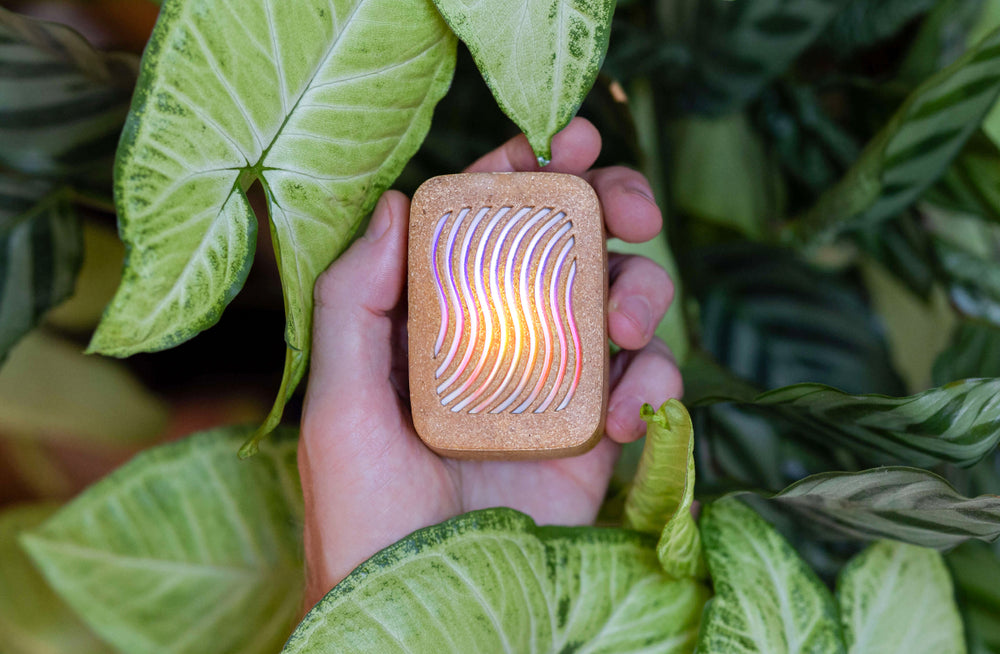
The PlantWave device: wireless, portable, and designed for beautiful biosonification experiences
PlantWave is patented technology built on more than a decade of research, artistry, and community. It grew out of:
- scientific inspiration from Bose
- curiosity sparked by Backster
- generative philosophy influenced by Brian Eno
- technical breakthroughs developed for MIDI Sprout
- and years of refining how to turn natural processes into emotionally meaningful sound
PlantWave isn't just a device — it's the heart of the modern plant music movement. In fact, the instruments and presets in PlantWave's app are still designed by Joe Patitucci to this day.
The Future of Biosonification

The future of biosonification: where nature, technology, and human creativity converge
We are entering a new era where:
- bio-data becomes creative material
- nature becomes a musical collaborator
- wellness meets art through sound
- signals expand from plants and fungi to human physiology and beyond
- real-time biosonification becomes part of daily life
PlantWave stands at this intersection — bridging technology and nature in a way that feels ancient, futuristic, and human all at once.
Sonification isn't just for plants — astrophysicist Sarah Kane uses the same principle to study the cosmos. Hear the conversation on the Nature of Now podcast.
Experience Plant Biosonification Yourself
If you're fascinated by:
- plant biosonification
- real-time biosonification
- generative plant music
- creating sound from nature
- deepening your relationship with plants
PlantWave makes it accessible, beautiful, and meaningful.