MIDI Sprout vs PlantWave
The Full Evolution
If you've been following plant music since the early days, you probably know MIDI Sprout, the device that started it all. What you may not know is that PlantWave is its direct successor, built by Data Garden with more than a decade of engineering behind it, and that it's evolved significantly beyond what MIDI Sprout could do.
This is the full story: where MIDI Sprout came from, what PlantWave adds, and why the upgrade path matters for musicians who've been in this space for years.
Where MIDI Sprout Came From
MIDI Sprout was commissioned by Data Garden and led by Joe Patitucci. The circuitry was built by Sam Cusumano, an electronics expert who designed the sensor hardware using a modified lie detector measuring galvanic impedance, connected to Pure Data for MIDI translation.
The device arose from demand created by the 2012 Data Garden Quartet installation at the Philadelphia Museum of Art, where four plants played together as a generative ensemble. After that installation, artists and musicians wanted access to the technology. MIDI Sprout was the answer, the first commercially available device to translate plant bioelectrical signals into MIDI using impedance measurement. A category that didn't exist before Data Garden created it.

MIDI Sprout shipped as a standalone device. One plant, one 5-pin MIDI output, one cable to your synth or MIDI interface. No wireless. Multi-device was possible by running multiple MIDI Sprouts through a DAW with third-party MIDI routing apps like MIDI Pipe, but it was not native. It worked, and it introduced thousands of people to the concept of biosonification, but it was limited by the hardware of its era.

Originally MIDI Sprout had no app. One was later added as a sound engine, but it required a MIDI-to-Lightning cable that is no longer manufactured, a limitation that directly drove the vision for PlantWave's wireless, app-integrated design.

The circuitry was open-sourced and available as a DIY kit, enabling a global community of makers and experimenters. The approach has since inspired other tools in the space, but PlantWave is the direct continuation of the original work.
For the complete origin story, including the Data Garden Quartet, the $32,000 Kickstarter, the cardboard enclosure that saved the company, and the pizza party that assembled 400 units, see the full history of plant music.
What PlantWave Adds
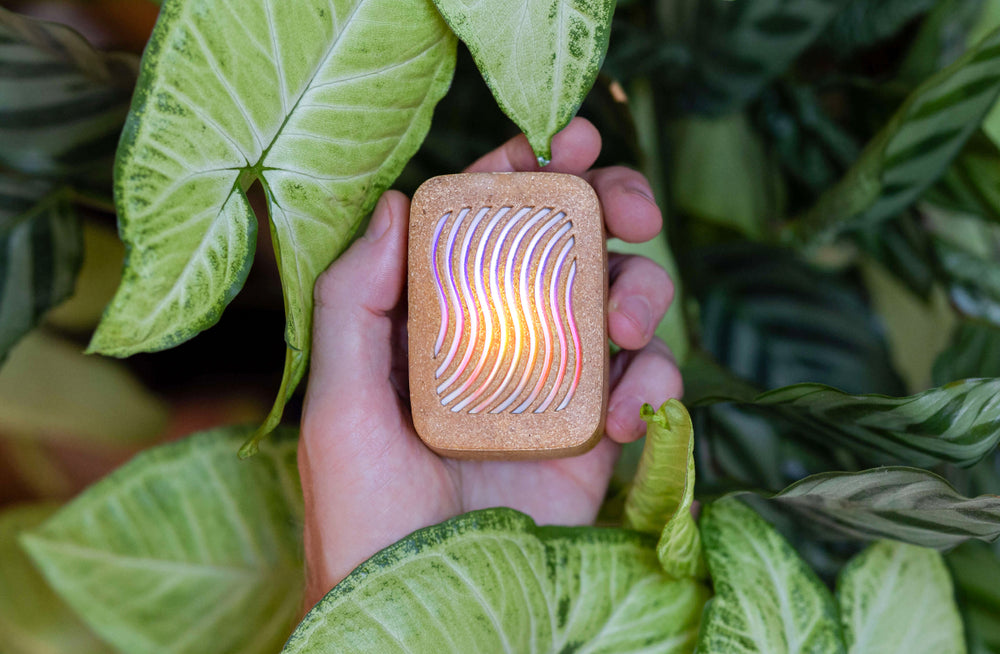
PlantWave is a ground-up rebuild by Data Garden, led by Joe Patitucci, not a revision of MIDI Sprout but a new platform carrying the same mission forward with more than a decade of engineering.

Wireless MIDI via Bluetooth
The PlantWave MIDI Bridge receives plant-generated MIDI wirelessly over Bluetooth and routes it into your Mac DAW, Ableton Live, Bitwig Studio, Logic Pro, or any Core MIDI app on macOS 13+. No cables between the plant and your computer. Per-device MIDI channel and CC assignment. This didn't exist in the MIDI Sprout era, and still doesn't exist for any other plant MIDI device.

More Connection Options
Beyond Bluetooth, PlantWave also offers WiFi (network MIDI) as a second wireless option, plus 3.5mm Type A MIDI and USB-C MIDI for wired connections. More connectivity options than any device in the space.
Multi-Device Support
No hard device limit, 4 PlantWave devices confirmed stable running simultaneously through the MIDI Bridge in testing, each on its own MIDI channel. Practical ceiling varies by Mac hardware and Bluetooth environment. Tested across multiple music settings including public performances and installations. Multi-device on MIDI Sprout required a DAW plus third-party MIDI routing tools (no native multi-device support).
Deep Firmware Configuration
Sensitivity, MIDI channel, CC number, root note, six scales (Chromatic, Major, Minor, Indian, Pentatonic Major, Pentatonic Minor), polyphony, all configurable via the app, web browser, or directly through the MIDI Bridge. MIDI Sprout offered only sensitivity adjustment, all other parameters were hardcoded. See the full PlantWave MIDI Specification for every configurable parameter and its default value.
Companion App
For non-DAW use: the PlantWave app translates the same signal into finished music through professionally designed soundsets. The device comes with 12 soundsets, with 35+ more available via subscription. This gives PlantWave a dual life, a listening experience for everyday use and a MIDI controller for studio work.
Quick Comparison
| MIDI Sprout | PlantWave | |
|---|---|---|
| Status | Discontinued | Active (current production) |
| Made by | Data Garden | Data Garden |
| Wireless MIDI | No | Yes (Bluetooth via MIDI Bridge + WiFi network MIDI) |
| Wired MIDI | 5-pin only | 3.5mm + USB-C |
| Multi-device | Via DAW + 3rd-party routing | No hard limit; 4 confirmed stable |
| Configuration | Sensitivity only (rest hardcoded) | Sensitivity, channel, CC, root note, scale, polyphony |
| App | Later addition (required discontinued cable) | iOS + Android (12 soundsets included, 35+ via subscription) |
| MIDI Bridge | N/A | Free Mac utility for Bluetooth routing |
| Engineering | First generation | More than a decade of development |
The Lineage
MIDI Sprout was the first commercially available device to translate plant bioelectrical signals into MIDI using impedance measurement, a category that didn't exist before Data Garden created it. The approach has since inspired other tools in the space, but PlantWave is the direct continuation of the original work.
If you used MIDI Sprout and moved on, the gap between what you had and what exists now is significant. If you're still running a MIDI Sprout, PlantWave is the upgrade path, and the MIDI Bridge adds capabilities that weren't imaginable when MIDI Sprout shipped. Ready to get started? See how to set up PlantWave with Ableton Live, or learn what plant MIDI CC actually measures and how to map it.
Get PlantWave, the direct successor to MIDI Sprout, rebuilt for wireless studio and installation use.