Generative art has long been defined by systems — rules, algorithms, and processes that produce variation over time. For decades, those systems have largely been abstract: mathematical functions, probabilistic models, and computational logic unfolding within closed environments.
A shift is now underway. Instead of generating form from purely synthetic inputs, artists are beginning to work with signals that originate outside the machine. Environmental data, physiological measurements, and biological processes are becoming inputs into real-time generative systems.
This raises a fundamental question: What happens when living systems become part of the generative process?
From Code to Living Systems

Joe Patitucci and Eduardo Castillo performing live with PlantWave. Photo by Roger Ho.
Traditional generative art is built on controlled unpredictability. Random number generators, noise functions, and rule-based systems create variation within defined boundaries. Even when complex, these systems remain internally consistent — governed by code, and ultimately repeatable.
Biological systems introduce a different kind of input. Plants, like all living organisms, exhibit continuous electrical activity. These signals fluctuate in response to internal processes and environmental conditions — light, moisture, temperature. When captured as data, they form time-based streams that can be used as inputs for generative systems.
This does not replace algorithmic structure — it extends it. The system becomes hybrid: part designed, part observed. Code still shapes the output, but the driving signal originates in a living process. This marks a transition from generative art as simulation to generative art as translation.
What PlantWave Actually Does
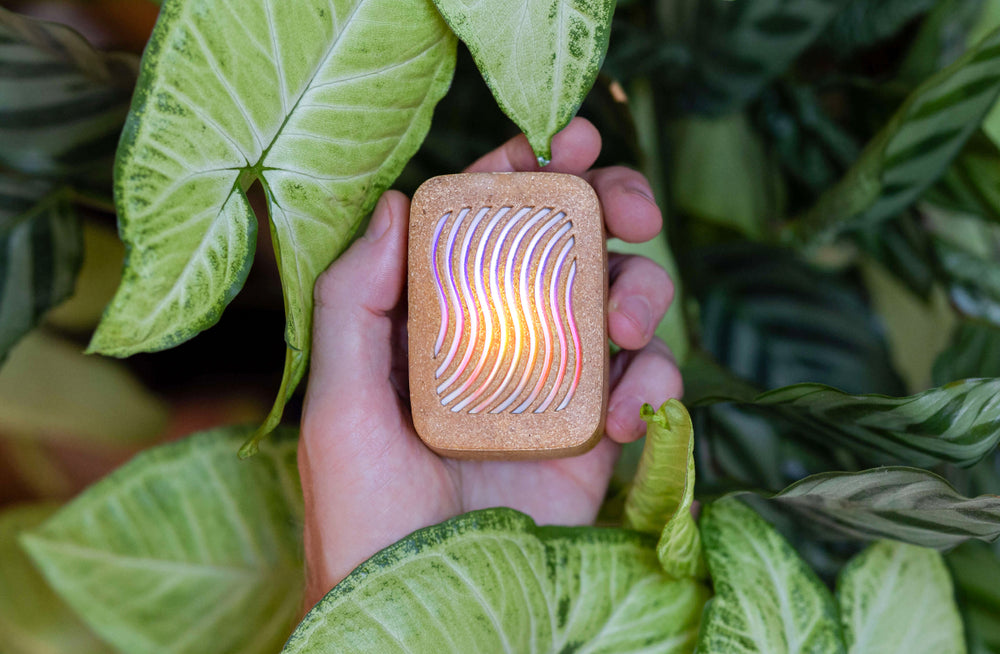
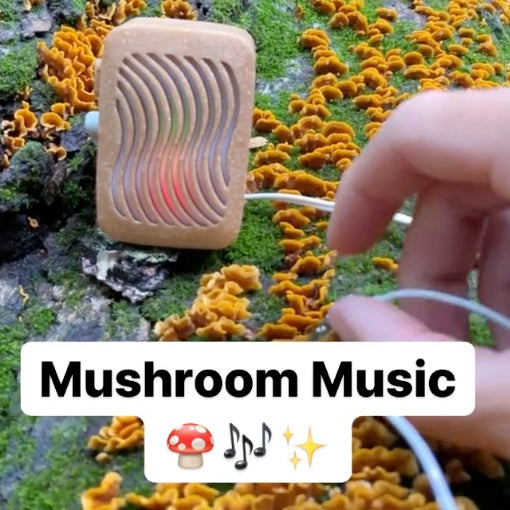
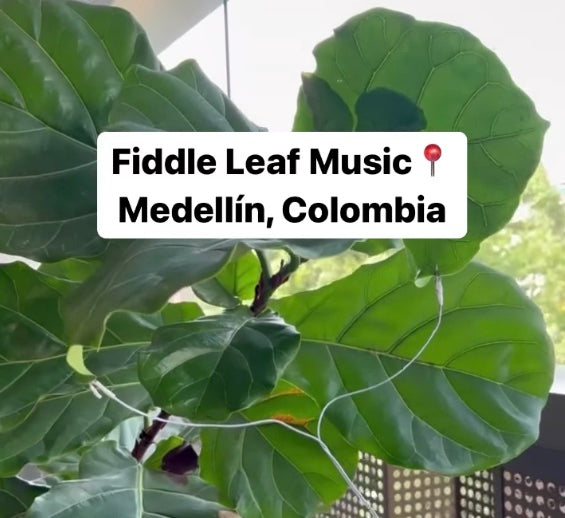
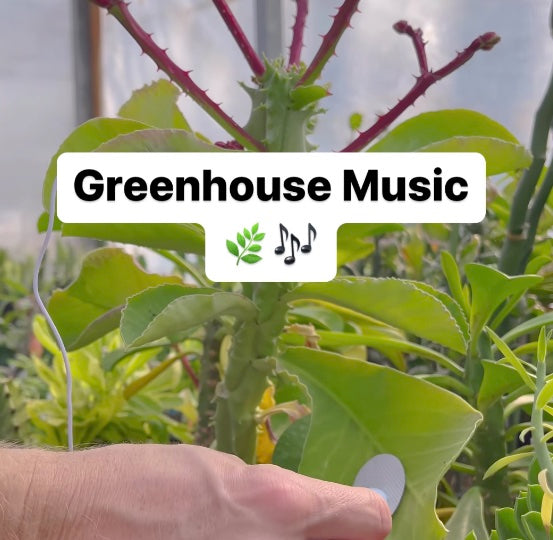
At a technical level, plant-based generative music systems operate through measurement and mapping. Electrodes are placed on a plant to detect changes in electrical conductivity — changes that reflect shifts in the plant's internal electrical activity. The signal is captured, converted into data, and mapped to musical parameters.
That mapping can include discrete events — such as note triggers — or continuous modulation affecting timbre, filter, or dynamics. The result is not a direct "sound of the plant," but a structured translation. The system interprets signal variation and renders it into a musical framework.
How Biological Signals Are Expanding Generative Art

Joe Patitucci and Nicole Miglis performing at SXSW with PlantWave-driven generative visuals. Photo by Roger Ho.
Plant-based signal systems introduce new properties into generative practice — properties that differ in kind from those of purely algorithmic systems.
Nature as Real-Time Input
Biological signals become active inputs. The system does not depict nature — it operates with it, unfolding in relation to ongoing processes outside the artist's direct control.
Data as Creative Medium
Biological data is not illustrative — it is structural. It shapes the timing, density, and evolution of the output, actively driving form in real time.
Organic Variability
Unlike pseudo-random algorithms, biological signals produce variability from complex, interacting processes — continuous without simple repetition, neither patterned nor chaotic.
Open-Ended Duration
When input is continuous, the system doesn't resolve into a fixed composition. It remains open — evolving indefinitely, responding to changing conditions without reaching a final state.
Indirect Interaction
Participants may influence conditions — light, proximity, environment — but the signal is mediated through the organism. Authorship becomes distributed across system, organism, and environment.
Subtlety and Attention
Bio-driven outputs operate at slower temporal scales, emphasizing gradual change and texture. They invite sustained attention rather than immediate impact — aligned with ambient and perceptual art traditions.
Biofeedback and Hybrid Systems
Plant signals are part of a broader movement. Human physiological data — heart rate, respiration, brain activity — can operate within shared generative frameworks, creating interconnected, multi-organism systems.
What This Changes — and What It Doesn't

Nicole Miglis and Joe Patitucci — a hybrid system where human performance and biological signal meet. Photo by Roger Ho.
What shifts
- Systems move from fully designed to partially discovered
- Authorship becomes less centralized — shaped by relationships between code, organism, and environment
- Time becomes more open-ended — ongoing variation rather than a finished work
- The source of variability is external and evolving, not internally generated
What doesn't change
- Plants are not intentionally creating music or performing in any human sense
- The signals are part of normal physiological processes
- The sound is a translation through a designed system, not a decoding of meaning
- The mapping is signal → data → structure → output
Maintaining this clarity is essential — for both scientific accuracy and artistic integrity. The work is not diminished by these limits. It is defined by them.
The Emergence of Biosonification

Listening to a living system — plant music as a form of sustained, perceptual attention.
The use of biological signals in generative systems sits within a broader field that includes sonification, environmental data art, and real-time system design. Biosonification, as a subset, focuses specifically on translating signals from living organisms into sound or other media — combining measurement, mapping, and aesthetic decision-making into a unified practice.
Plant-based systems represent an early and accessible entry point within this field. They demonstrate how living processes can function as inputs without requiring invasive measurement or complex infrastructure.
As tools and techniques develop, the field is likely to expand — integrating multiple signal types, refining mappings, and exploring new forms of output across sound, image, and spatial media. What's consistent is the underlying idea: living data as a meaningful source of generative form.
An Opening, Not an Endpoint
Generative art is no longer confined to code.
As biological signals enter the system, the boundary between designed processes and living processes begins to blur. Artists are not only constructing systems — they are situating them in relation to ongoing, dynamic phenomena.
This does not replace traditional generative approaches. It extends them — introducing new forms of variability, new questions of authorship, and new modes of perception. Working with biological data invites a different kind of attention: a shift from control to observation, from composition to translation, from isolated systems to interconnected ones.
Hear artists discuss how they create generative work with plants: What is Plant Music? on the Nature of Now podcast. And for sonification beyond plants — astrophysicist Sarah Kane uses the same principle to study the cosmos.
Experience It Directly
PlantWave translates a plant's live electrical signals into real-time generative music. Free recordings are on YouTube — or bring the system into your own practice.
Listen on YouTube Get PlantWave